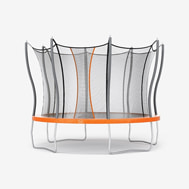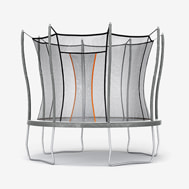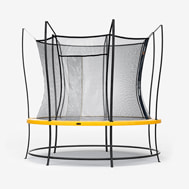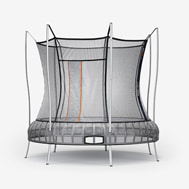

Many people believe that trampolines are generally the same. While they do look similar to the untrained eye, these highly versatile devices often do not share many similarities. Trampolines come in all kinds of shapes, sizes, and are built for specific purposes. Comparing a backyard trampoline with the trampoline at the local sports club will reveal drastic differences in both style and quality. Although their essential purpose is to provide a jumping surface, the differing size, shape, and amount of bounce are dramatically differ. Trampolines can be specifically designed for fun, fitness, or stress relief. Some trampolines are used for professional purposes while others are solely for recreation. New trampoline uses are constantly being invented, and trampolines continue to evolve to meet the ever-changing needs. Trampolinists must keep their intended purpose in mind when buying a trampoline. Read on to learn more about the many trampoline options that are available!
Rebounder
One of the smallest trampolines is the rebounder, or mini-trampoline. These small, compact trampolines are often seen in exercise videos or television programs. They are small enough to be hidden-away in a closet or under a bed when not in use and are effortlessly concealed. Their unobtrusive size makes them a perfect choice for individuals who live in a small home or in an apartment.
Rebounders are designed to be used indoors by a single person and are intended to help elevate the heart-rate through vigorous movements. There are many variations that can be made to increase or decrease the intensity of the rebounding workouts. In fact, many exercise routines are designed to specifically incorporate the rebounder into the routine. The low-impact nature of the jump-mat can help alleviate the stress on the feet and legs that is associated with high-impact activities like running. Rebounders are superb exercise devices for those who suffer from joint pain, poor muscle tone, or poor circulation. These handy trampolines are also ideal for improving balance and coordination.
Rebounders have been used for decades. They are one of the few exercise tools that have retained immense popularity over the years, due to their enjoyable and effective home-gym qualities. Rebounders are perfect for those who do not enjoy running or outdoor exercising, and are an inexpensive addition to any workout program. The simple, yet effective motion of rebounding ensures that users can multitask while exercising. Many jumpers use their rebounders while watching TV, reading, or talking on the phone
Rebounders are fantastic exercise tools for frequent travelers or vacation enthusiasts, as they are easily transportable and take only a few moments to retrieve and prepare for jumping. Some rebounders come with a carry-bag to guarantee easy transportation. Similarly, many rebounder enthusiasts have created their own exercise groups that meet at different locations every week to increase the excitement. Mini-trampolines are easily assembled and can fold up easily in any size vehicle. Rebounding is one of the safest, most effective workout tools on the market. Many rebounders come with stabilizer bar that aids the user in retaining balance. Stabilizer bars may be padded or unpadded, and may come with hand grips to help the user gain a firmer hold for coordination. Rebounders are perfect exercise devices for users of all ages, sizes, and lifestyles. They pose almost no safety risk and provide hours of bouncing fun!
Gym / Olympic
Olympic, or gym, trampolines stand in stark contrast to any other trampoline models. These large trampolines are designed specifically for maximum performance and safety in mind, and provide immense amounts of power and propulsion. Many gym trampolines are specially designed for the Olympic Games and gymnastics clubs. Gym trampolines are the most expensive of all trampoline models, and can cost more than $10,000. Due to their increased power and performance, these devices are recommended for trained individuals only.
Olympic trampoline jump mats are manufactured to be like netting and are much more porous than the average backyard trampoline jump-mat. The porous design allows more air to easily flow through it and gives it incredible amounts of force. The rebound that can be gained from an Olympic trampoline is enough to allow professional gymnasts to complete multiple twists and rolls in the air.
Olympic trampolines are not limited to gymnasts. In fact, they are also great for divers to use in practicing the twists and turns normally performed during a dive. Some skiers have also discovered Olympic trampolines to be invaluable training tools to aid in their twists and turns during jumps. Gym trampolines are also frequently used by circus acrobats to perfect their routines before presenting them to audiences.
Due to the height that can be gained from these trampolines, the safety-padding around the edges of the frame is significantly thicker than that of recreational trampolines. This helps to protect any users who may lose control and land on the frame area. Additionally, gymnastics centers also place padding around the outside of the trampoline to protect any jumper that loses control and bounces off of the device. Gym trampolines are highly valued for their ability to launch the user to incredible heights. Unfortunately, falls from such heights are almost guaranteed to result in a major injury. Although the safety padding does help absorb the impact of an accident, fall-related injuries can still occur. For this reason, users on Olympic trampolines are under careful supervision at all times.
Some manufacturers produce very large recreational trampolines to attract amateur gymnasts; however, the cost involved in purchasing one of these trampolines are frequently outside of the average person’s budget. Furthermore, these recreational trampolines are impractical for serious-minded trampolinists. Most lawns cannot accommodate the space requirements needed to accommodate a large trampoline and the safety padding. Budding trampolinists who wish to attempt advanced trampoline tricks and maneuvers will benefit from a gymnastics club on a professional device and under professional supervision.
Backyard
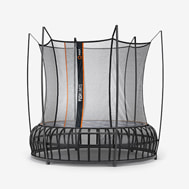
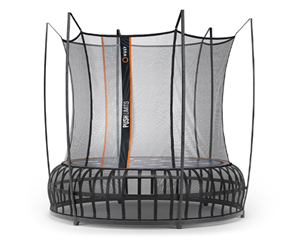
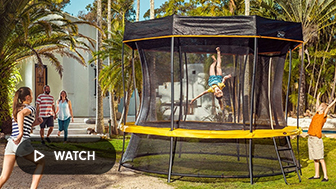
Backyard trampolines have always been a staple of childhood fun. New technological advancements have made the time-honored backyard trampoline safer, more enjoyable, and more widely available than ever before. Although backyard trampolines may not produce as much power as Olympic trampolines, most users delight in the height that the moderate jump-mat provides. Backyard trampolines are affordable and space-efficient, making them a perfect recreational tool for families of all backgrounds.
The exploding popularity of trampolines results in a wide range of trampoline models. The quality of recreational backyard trampolines can differ greatly between manufacturers, so it is important to always investigate the general design and the materials used in each product. Trampolines are an investment that can be enjoyed for many years to come, so choose your model carefully!
Vuly leads the way in providing quality trampolines at competitive prices. We use the highest-quality materials to give your family the best, safest result. Our superior design is immediately apparent upon inspection, and we pride ourselves on having the most durable, safest recreational trampoline models in the industry. Contact one of our customer service representatives for a full explanation of Vuly’s innovative safety features, safety tips, and expert advice.
Backyard – Rectangle
Backyard trampolines come in many shapes and sizes. When choosing a backyard trampoline for your family, it is important to consider what shape will best suit the users’ needs. Jumpers’ age, weight, and skill level plays a crucial role in the trampoline research process. Read on to learn more about the qualities of rectangular trampolines!
Earlier backyard trampoline models came only in a rectangular shape. While this shape has waned in popularity, rectangular designs are still available. Today, rectangular backyard trampolines are most commonly used by trained gymnasts and expert trampolinists. This shape is the most powerful because more springs act in the same direction, giving the user a greater rebound with increased height.
Rectangular trampolines are made of thick steel to withstand the impact of the rebound. While the steel creates a sturdy, solid structure, it also makes the rectangular trampolines heavy and difficult to move around. The heavy design these trampolines make them impractical for most families. Additionally, rectangular trampolines cost twice as much on average as the leading circular trampoline models. Rectangular trampolines are not an economically efficient choice for most individuals.
Rectangular trampolines do have distinct advantages. One of the most coveted qualities of this shape is their ability to fit nicely in a corner or off to one side. Their orderly appearance is very aesthetically pleasing and effortlessly complements the rectangular shape of most backyards. The angular shape is also beneficial when creating an in-ground trampoline, as the frame can be measured to suit the exact dimensions.
Purchasing a rectangular trampoline is not recommended for inexperienced or recreational trampolinists due to the irregular shape of the frame. The rectangular design is prone to uneven frame wear because the force of impact tends to be directed to specific points along the frame. Users have to carefully calculate their landing in order to avoid injury or frame damage. If the user’s weight is not evenly distributed across the entire jump-mat, they will experience an unexpected rebound that may cause injury. This risk is increased as the user moves closer to an edge or corner. All jumpers using a rectangular trampoline need to be carefully supervised at all times.
Round
Standing in stark contrast to the rectangular trampoline is the much-favored circular or round trampoline. This shape has become so popular that many manufacturers solely focus on providing this design. In fact, the circular design is the most common trampoline shape in the industry today.
Round trampolines are highly recommended for users of all ages, and they are among the safest trampolines on the market. Innovative safety accessories and design improvements are constantly developing for use in round trampolines. These ever-changing innovations are especially valuable for the widespread safety and well-being of families with children.
Round trampolines are also highly economical. This design requires less steel to be used for the frame because entire frame absorbs the forces applied to it each time a person jumps. The decreased amount of weight that is needed to create a sturdy frame results in a less expensive, safer device for your family. The lightweight round shape is also much less expensive to ship than other conventional trampoline models.
The circular nature of these trampolines causes each of the springs around the entire circumference to somewhat evenly stretch. This feature applies equal forces around the entire frame, rather than the uneven force distribution that occurs with rectangular trampolines. Additionally, circular trampolines provide an even rebound response throughout the center jump-mat, and the trampoline tends to push the user back towards the center if they start to get close to the edges. This crucial quality means that trampoline users do not have to carefully calculate their movements. Instead, they can focus on reaping the physical and mental benefits of rebounding.
As less steel is used in the circular design, circular trampolines are much easier to lift and move around than many other styles of trampolines. They are usually light enough to be assembled and transported by one person. Their convenient size makes them easily positioned into place on the lawn, and they can be effortlessly disassembled and moved to other desired locations Deciding on the right trampoline model takes extensive research and considerable thought. If you have any questions, comments, or to request more information, please call our knowledgeable customer service team.